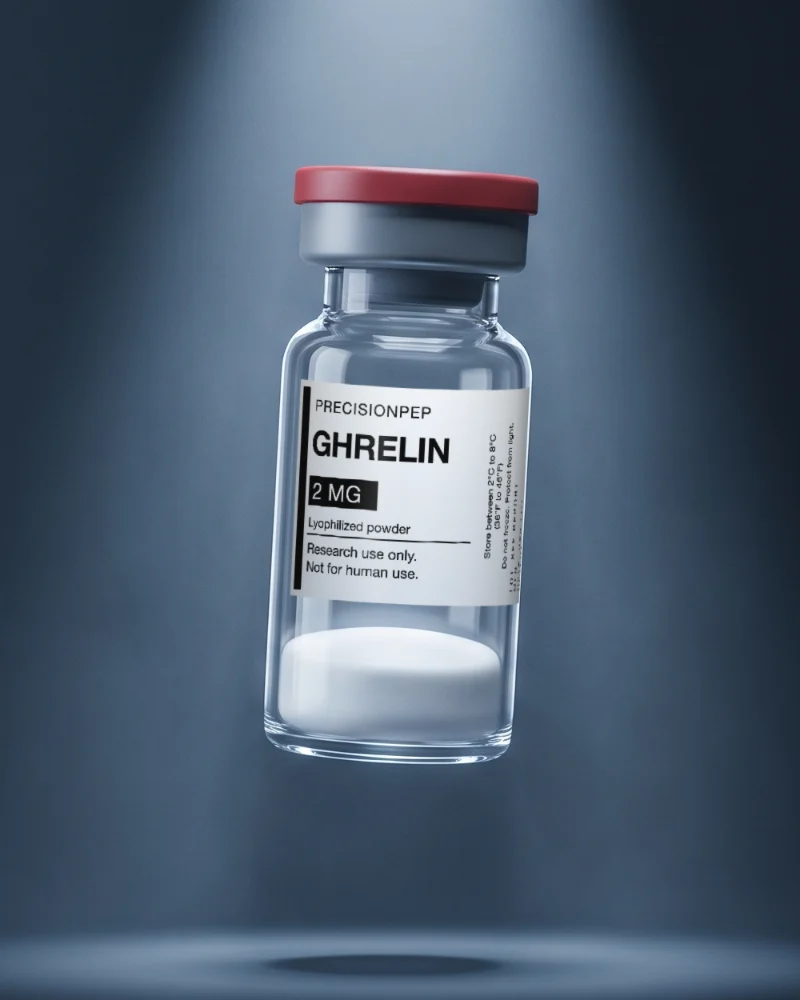
What it is
Ghrelin is made mostly in the stomach. The enzyme GOAT attaches an eight-carbon octanoyl group to serine 3, and that acyl group is what lets ghrelin bind its receptor. This product is the acylated human form.
What researchers study
- The natural ligand of the growth hormone secretagogue receptor, GHS-R1a, also called the ghrelin receptor.
- Studied in research on growth hormone release, appetite and energy balance.
- A reference ligand for comparing synthetic ghrelin-receptor agonists such as GHRP-6 and ipamorelin.
Specifications
| Sequence | GS-S(octanoyl)-FLSPEHQRVQQRKESKKPPAKLQPR |
| Molecular formula | C149H249N47O42 |
| Molecular weight | 3370.9 g/mol |
| PubChem | CID 91668172 |
| Form | Lyophilized powder |
| Vial sizes | 2 mg |
| Storage | Unopened: 2 to 8 °C, away from light |
How each lot is tested
Samples from every lot go to an independent, ISO/IEC 17025 accredited lab. Its report covers three tests:
- Purity by reversed-phase HPLC: the main peak's share of the total peak area.
- Identity by mass spectrometry: the observed mass should match the expected 3370.9 g/mol.
- Endotoxin, measured for every lot.
The lot number on your vial is the number on its report. How to check a certificate of analysis walks through what to look for.
The amount on the label is the weight of the powder. Besides the peptide it includes counter-ions and some water; Purity vs. peptide content explains the difference.
Storage and handling
Store unopened vials at 2 to 8 °C, away from light, as printed on the label. Let a cold vial reach room temperature before you open it, so moisture doesn't condense on the powder. More bench habits are in Handling.
For laboratory research use only. Not for human or veterinary use. This page describes the compound and published research on it. It is not a recommendation for any use.